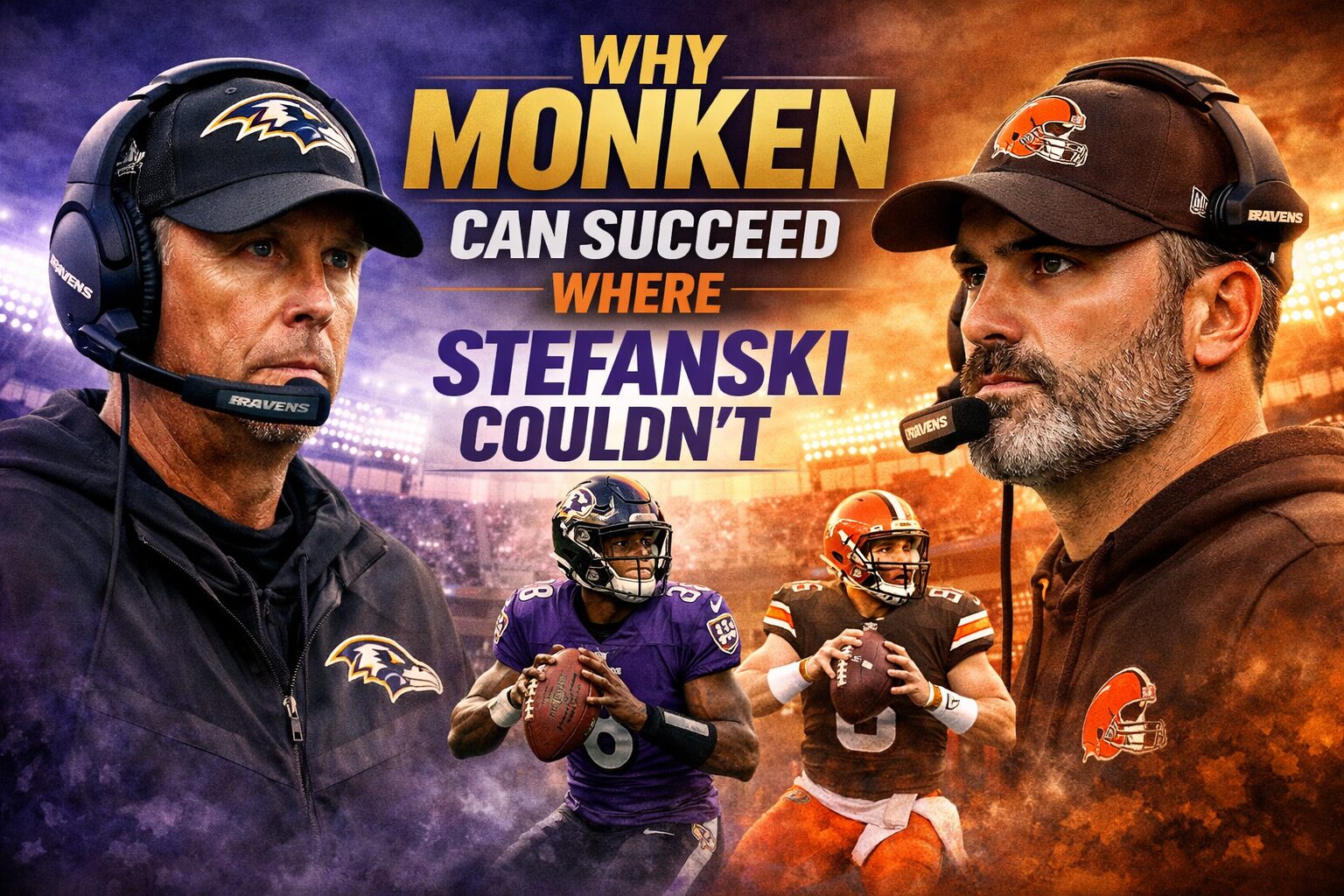
Kevin Stefanski is a good, solid head coach. It was a shame that the Cleveland Browns needed to fire him. But it was time.
Obviously, eight wins in two seasons is unacceptable for pretty much any NFL team (except those coached by Hue Jackson). It wasn’t the win totals that did Stefanski in, however. Stefanski’s failure didn’t come as a head coach; it came as an offensive coordinator.
Yes, Stefanski had an offensive coordinator each of his six seasons. But they were coordinators designed to aid Stefanski in calling the plays, rather than take that particular ball and run with it themselves. Alex Van Pelt held the role for four years and was followed by Ken Dorsey in 2024. Both were experienced former quarterbacks who excelled as QB coaches. But neither found any success in calling the plays. At the same time, none of the quarterbacks who came through truly excelled in the system, beyond a short four-game stretch for Joe Flacco in 2023.
In 2025, Tommy Rees took the mantle. Rees came from the same mold: Quarterback on the field, quarterbacks coach after. Rees took over playcalling midway through the 2025 season as the Browns headed towards another year of historical offensive ineptitude. But the die was cast: The offensive line was well past its prime, none of its receivers could find a way to step up, and Shedeur Sanders was a raw talent learning on the fly.
In contrast, the defense was run by Jim Schwartz for Stefanski’s final three seasons. Under Schwartz, a defensive coordinator who found success at nearly every stop, the unit quickly became one of the top defenses in the league. The talent was better, but the team also managed to find and develop players in a way the offense never did.
(Note: I’ve long thought that Stefanski’s training/strength & conditioning staff was responsible for far more injuries than any NFL team should have. But that’s well out of my expertise, so I’m not going to comment on it beyond noting it here.)
In short, Kevin Stefanski would still be the head coach of the Cleveland Browns if he had found the Jim Schwartz of the offense. Maybe Tommy Rees is that guy, but he’s young and developing. Thrusting him into the limelight in the midst of a broken season was a worthy experiment, but ultimately doomed to be a failure.
Stefanski’s failures as an offensive leader stemmed from his stubborn inability to accept that his offense was outdated. This is why I have an innate fear of hiring offensive coordinators as head coaches. Many stick with their systems far beyond any reasonable point.
That’s why I strongly favored hiring John Harbaugh when he became available, with Jim Schwartz as a backup plan. I’ve long admired Harbaugh as a coach. He came from a special teams background, so no baked-in system either way. Just discipline and leadership. Harbaugh, however, clearly preferred New York and declined all other interviews.
Like everyone, I didn’t see the Todd Monken hire coming. I wasn’t terribly excited when I first heard his name.
But then, the more I heard, the more I liked. Monken was brought into Baltimore in 2023 to revive Lamar Jackson and the Ravens’ offense. Jackson was coming off his worst two-season stretch as a pro. His touchdowns, passing yardage, and completion percentage had declined significantly.
Monken’s offense vaulted Jackson right back up to league MVP in his first season. Though he didn’t repeat as the league MVP in 2024, Jackson had one of the best statistical seasons in league history.
The most important thing to note about this streak is that Monken designed his offense specifically for Jackson and the talent that he had available to him. Harbaugh himself has noted that Monken is a valuable coach who is not a “system guy”. Where Stefanski favored a strict structure that reduced errors, Monken is known as much more aggressive.
At today’s press conference introducing Monken as the team’s head coach, he said that one of the reasons he came to Cleveland was the opportunity to build an offense from the ground up. That certainly is true. Right now, Cleveland has a solid running backs room, a stud young tight end (okay, that sounded wrong), and Jerry Jeudy, a talented receiver who may or may not be able to catch a ball.
It also has two big question marks at quarterback. The aforementioned Sanders came to the team as a fifth-round pick after a perplexing fall in the 2025 NFL Draft. Statistically, he was horrific. But Sanders flashed an X-factor that hadn’t been seen from a Browns quarterback in a long time, and the team played better with him on the field, going 3-4 (yes, three wins is a high-water mark when you only win eight in two years).
The other is Deshaun Watson. Watson, entering his fifth season in Cleveland, has been a massive disappointment since joining the team in 2022. Cleveland surrendered more than three first-round picks to get him, while signing him to a $230 million, fully guaranteed contract. He has played only 19 games due to a litany of injuries, and looked uncomfortable, flat, and uninspired in doing so.
Given the investment in Watson and the flash from Sanders, it is very likely that these two will be competing for the QB1 spot in Cleveland. Both seem to come from the Monken mold: They are mobile-ish quarterbacks that are comfortable improvising and have strong arms to take shots down the field.
If Monken can make it work with one of these two quarterbacks and hold the defense together (a big if that I’ll revisit in a future post), Cleveland isn’t actually that far away from being competitive. The aging offensive line comes off the salary books, as does Amari Cooper’s contract, meaning the Browns can actually make a high-dollar free agency move. They hold two first-round picks, and their No. 6 overall choice in each round should net them a chance at pulling 3-4 starters from the 2026 draft. At a minimum, two of those will have to be offensive linemen and one top receiver.
While Monken’s hiring may not have been the most exciting move the Browns could have made, it may well turn out to be the right one. More later, as the staff gets put together.